Swiss Week in Hebden Bridge: A Forgotten Celebration of Yorkshire's "Little Switzerland"
Following a recent donation of photograhs, in this guest blog volunteer Ella explores the history of Swiss Week, a little-known part of our history from the 1940s until the 1970s.
For many years, Hebden Bridge played host to a unique annual celebration known as Swiss Week, a gathering that reflected both the town's remarkable landscape and its unexpected connection to Switzerland. Evidence from the Swiss Observer of 10 June 1966 notes that the gathering scheduled for 19th June that year would be the eighteenth Landsgemeinde.
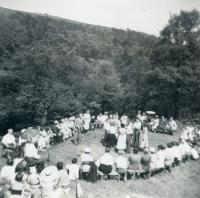
Swiss Week. HBC01583 from Pennine Heritage Digital Archive
At the heart of Swiss Week was the Landsgemeinde, an annual gathering held in the dramatic surroundings of Hardcastle Crags. The event attracted Swiss residents from across northern England and was led by Professor J. C. Inebnit. More than simply a social occasion, it served as a celebration of Swiss culture, identity, and community. Starting in 1948, Inebnit, stated “The Swiss, mainly from the West Riding and Manchester, have gathered there every third Sunday in June since 1948 to evoke a few echoes of their home country.” The post-war years saw growing efforts to foster unity and cooperation between European nations. According to the Swiss Observer, many Swiss citizens found themselves in a unique position during this period. Having remained neutral throughout the war and avoided military alliances, Switzerland's relationship with the wider movement towards European integration was often complex. Events such as Swiss Week may have provided an opportunity for Swiss expatriates to celebrate their shared heritage while strengthening connections with communities abroad.
Inebnit was a distinguished Swiss linguist and long-time professor of French at the University of Leeds. His historical ties to the Calder Valley community included hosting events for the local Swiss community. He was also known for his humanitarian aid following World War II with relief efforts for children in Europe and was heavily influenced by Quaker ideals.
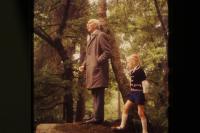
Professor J. C. Inebnit. DEF00867 from Pennine Heritage Digital Archive
The traditional gathering started with a meeting at 10.20 a.m. at the Memorial Park at Hebden Bridge and a walk through the countryside of Hardcastle Crags. After the walk came a picnic lunch and barbecue, usually held around 2 p.m. near the restaurant and campsite in the Crags.
The highlight of the day was the Landsgemeinde itself. During the ceremony, participants formed a large circle around Inebnit. Standing in the centre, he would call out the year each Swiss canton joined the Swiss Confederation. Those originating from the named canton stepped into the middle of the circle. As the ceremony progressed and more cantons were announced, the circle gradually filled until everyone stood together in the centre, a symbolic representation of Swiss unity. Following the ceremony, the group returned to Hebden Bridge at around 4 p.m., where High Tea was served in the Civic Hall in the presence of local dignitaries and guests.
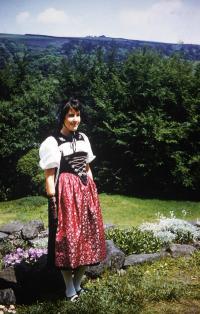
HBC01509 from Pennine Heritage Digital Archive
In 1972, Hebden Bridge Junior Band took part in its first Swiss Week celebration, a year after they had formed. While members of the Swiss community stopped coming to celebrate Landsgemeinde during the 1970s, the town continued to roll out the flags with local bands playing a central role.
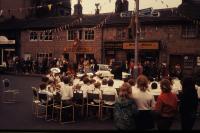
Hebden Bridge Junior Band. DEF00866 from Pennine Heritage Digital Archive
But why was Hebden Bridge chosen as the venue for such a gathering? The answer lies in the landscape. During the nineteenth and twentieth centuries, Hebden Bridge became known as the "Switzerland of Yorkshire". Its steep-sided valleys, rushing rivers, wooded hillsides, and rolling meadows reminded many visitors of the scenery found in the Swiss Alps. Nowhere was this comparison more apparent than in Hardcastle Crags, whose rugged terrain and natural beauty evoked memories of home for many Swiss visitors.
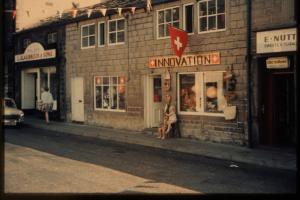
Furthermore, Swiss Week extended beyond the gathering in Hardcastle Crags. Although at the time Swiss week began, Hebden Bridge was a traditional, working class, industrial mill town, the town itself embraced the celebration, decorating streets with bunting and hosting additional events throughout the week. For residents, the festival brought an international flavour to the valley, strengthening relationships between Swiss visitors and local people, creating a cultural exchange that was unusual for a small Yorkshire town in the mid-twentieth century and contributed to a growing sense of openness and hospitality. By the time the annual Swiss week was no longer celebrated, Hebden Bridge had gained its reputation as a welcoming and outward-looking community.
Perhaps part of that cultural exchange came from the twinning movement as the primary goal was to foster that friendship fund here between Hebden Bridge and the Swiss population in the north.
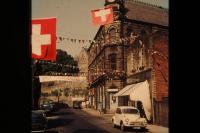
Crown Street, Hebden Bridge, during Swiss Week. DEF00929 from Pennine Heritage Digital Archive
Today, Swiss Week is largely forgotten, there are still links between Hebden Bridge and Switzerland, as 1st of August is both Yorkshire Day and Swiss Day. As well as this, there is a walking trail described as “the Switzerland of Yorkshire Circular”, reminding us the namesake is still used to describe the town.
In many ways, Swiss Week reflected values that remain associated with Hebden Bridge today: community participation, appreciation of the natural landscape, and openness to people from different backgrounds. The story of Swiss Week also offers a reminder that Hebden Bridge's reputation as a welcoming and cosmopolitan community has deeper historical roots than many might realise and remains a fascinating chapter in Hebden Bridge's history.
The celebration highlights the town's international connections and demonstrates how its distinctive landscape helped forge cultural links that stretched far beyond the valleys of West Yorkshire. The celebration also reinforced the enduring image of Hebden Bridge as the "Switzerland of Yorkshire." While the phrase is less commonly used today, the area's dramatic scenery continues to attract tourists, walkers, and nature enthusiasts, contributing significantly to the local visitor economy. Locations such as Hardcastle Crags remain among the region's most popular attractions, drawing visitors for the same landscape qualities that first inspired comparisons with Switzerland.